Foreign Policy continues to offer a surprising range of coverage on Afghanistan beyond the twists and turns of political intrigue and military policy. Today they've posted photographs taken by students in Kabul as part of an exchange project with a Philadelphia high school.
Thursday, June 17, 2010


Wednesday, June 16, 2010
In the footsteps of [insert name here]
In his introduction to the latest edition of Robert Byron's The Road to Oxiana, Rory Stewart writes of walking through Herat and then sitting to describe the city on paper: the image of the European-uniformed traffic officers seemed the perfect vignette, if somehow too familiar. He recalled cracking open Eric Newby's A Short Walk in the Hindu Kush and finding a description of exactly these traffic police, and yet the language felt unfamiliar. Opening Byron's text, he found that someone else had indeed already put in print exactly what he had hoped to say.
Kabul feels this way some days - each of us who comes here indulges a sense of novelty, of seeking the exotic and pioneering the unfamiliar in a place that even today feels very far from home. And yet, even preparatory reading for such a journey reveals this adventurer's path to be quite well-trodden indeed. There is nothing new under the sun for the would-be wanderer: wherever you go, some young Brit probably got there more than a century before, caught some exotic disease doing so, and got a Geographic Society medal for his efforts. What fun is it to repeat the trek with modern vaccines and easy air travel? As Rory found, they probably documented it more eloquently, to boot.
The colonialists of the Great Game weren't even the first to beat me here, despite the unusual flair with which they did so. Last summer, I visited an exhibition of Afghan National Museum pieces at the Metropolitan Museum of Art. The first room displayed relics from Ay Khanum - a Greek city built by Alexander the Great on the Oxus River. The Oxus is now the Amu Darya, but somehow the idea of a pagan temple in Afghanistan seems even more incredible thing from contemporary Kabul than when I marveled at its ruins in New York. Other exhibits offered scraps of Silk Road riches - Venetian glass, Indian furnishings, Egyptian idols. I write as one seeing something new and yet undiscovered, and still try to remember that all I see is familiar to many others. I have much to see for myself, but what I write here is but a pale imitation of the many who have already told this tale.
Sunday, June 13, 2010
The Excellent Educational Center
...or, on my budding second career in public speaking...
On my very first day at the Afghanistan Independent Human Rights Commission, I met Reza. He stopped into Safi's office specifically to say hello, requested my email, and immediately sent me a welcome detailing his own contact information in case I needed anything. He proceeded to introduce me to many others over the days that followed - always as the intern from Harward. I love Reza, so when he told me his cousin runs an English school, and that he'd like for Lea and me to visit sometime, I happily agreed.
We went Friday afternoon. As we sat in the director's office, he explained that there would be a speech competition that afternoon, and that Lea and I would be introduced as guests of honor and invited to speak for 5 minutes apiece, with time for questions to follow. Then we walked across the street to another classroom building. The room had nearly 200 people, but seats were reserved in the front row for our little troupe.
The competition began with the elementary students, 8 and 10-year-olds who spoke on the question: "is it difficult to govern an uneducated country?" One said yes; without money, there is no education, and without education, we learn only from our fathers and grandfathers and never change. The winner called leadership without education "a bird without wings."
The intermediate class tackled the prompt "our culture must survive." All contrasted Islamic culture with competing forces - one of the three didn't even mention a distinct Afghan culture within the religious tradition. Another called Afghan culture "the best culture" and called for national unity in respecting diverse traditions in order to protect them from outside influences.
Finally, the most advanced students grappled with "do humans deserve to be called supreme creatures?" One girl humbly declared that we were so only because God had given us this title. The boy who followed commmented that "man is a great yet careless creature," while the winning girl discussed the social sciences and our tendency to study our own flaws rather than celebrate the essential goodness of humanity. She declined to pass a verdict: "as we are the jury, we are uncertain of our choice."
Lea and I were introduced, and she then spoke about how many opportunities her own education had given her, while Reza translated for the many parents in the room. I then stepped forward and asked how many of the students had traveled to other countries, and a few hands went up. I asked how many had been to Europe, the Middle East, or the Americas, and a very few hands stayed up. I told them that I hadn't traveled very far when I was young, but that I had read a great deal about other places and studied languages - and that eventually these studies allowed me to see the countries I had learned about through books. I finished with a silly line about how pleasing it was to see their dedication and progress, and we opened the floor.
One speech contestant asked if the students' English was actually any good, and what we liked about Afghanistan so far. A younger girl wanted to know what we thought of the weather - and the government (we evaded the latter question). Lea asked one mother about her thoughts on education and she spelled out her hopes for her children in some detail.
We beamed at the over-generous applause and sat back down as the director announced class awards and handed out end-of-term certificates. Only then did I realize that we'd been the graduation speakers, essentially. I felt ashamed - some foreign dignitaries. I hadn't even practiced remarks properly! In any case, the welcome was warm, and I've now been invited home for dinner by Reza's father, who has also promised to find me a nice Afghan boy to marry... a productive Friday indeed.
Thursday, June 10, 2010
The daily grind - a Kabul commute
(new photos added 6pm, 6/10/10)
I've spent some part of the last week snapping photos out the car window on the way to and from the office. Most of them are blurred by the motion, or marred by traffic driving through the shot, but the handful I've collected here offer some view of the Kabul I see day-to-day. Enjoy!

click for the full album
I've spent some part of the last week snapping photos out the car window on the way to and from the office. Most of them are blurred by the motion, or marred by traffic driving through the shot, but the handful I've collected here offer some view of the Kabul I see day-to-day. Enjoy!
click for the full album
Tuesday, June 8, 2010
Joking around
My colleagues love to tease and are quick to laugh. Sometimes I don't really get what's so funny, and at other times I join in the fun. Some jokes I've been told over the last few days:
On marriage:
A wealthy Pakistani man returns after a time in America. Stopping in to make a small purchase, he tells the shopkeeper that he's looking for a wife, and where should he begin the search? The shopkeeper returns home and tells his young daughter that a rich man - with a green card - is looking for a wife, and would she maybe want to marry him and go to the US? The daughter agrees, and so wedding planning begins.
After the party, the newlyweds return to the groom's hotel, where he first peels off a toupee, then pulls out his false teeth... and then leans down to unscrew his artificial leg. The bride runs screaming back to her father's house, where she storms in to yell at him: "You didn't tell me he was falling apart!"
On Afghans and Arabs:
Two Afghan men traveled to Jordan. Arriving in the airport, they became separated briefly. One of them stumbled across two Jordanian men arguing - their voices raised, gesturing wildly. The Afghan watched, baffled, for a moment, but soon wandered on and found his friend again. He told him: "Jordanians are strange! You'd never believe what I saw - these two meen were fighting, and even then all they do is yell from the Qur'an!"
(this because most Afghans would encounter Arabic primarily, or exclusively, via readings of the Qur'an, but wouldn't necessarily understand enough to recognize non-religious conversations or arguments from these formal readings.)
Monday, June 7, 2010
Updates from the AIHRC
The Afghanistan Independent Human Rights Commission was founded eight years ago yesterday - June 6, 2002. Staff here commemorated the day with tea, cake, and a brief speech from Dr. Sima Samar, the chair of the commission. She noted that 8 years old is equivalent to a third-grade student, with much already learned and yet much more to do, and then spoke directly to a number of different programs within the Commission.
I was proud because the election-monitoring team, formed that very day, received a brief mention. As hoped, I will be spending my summer receiving data from AIHRC field offices on political rights and violations complaints, then helping to write reports and regular press releases. Coming soon - a primer on the electoral system and possibly some of the candidates involved in September's elections, which will choose the Wolesi Jirga (the lower house of the legislature - the upper house, or Meshrano Jirga, is an appointed body).
It was also an opportunity to meet Dr. Samar. She was reportedly nominated for the Nobel Peace Prize last year (nominations and deliberations are not made public for 50 years), and some commentators mentioned her as a superior candidate to President Obama. She served as the first Minister of Women's Affairs and founded a women's rights organization called Shuhada (where Afreen is working for the summer). More recently, she was also appointed the UN special reporter on Darfur and named one of Forbes's 100 Most Powerful Women.
The days remain quiet as work plans remain in the formative stage, but as voter registration begins on June 12, it's certain to get busier quite soon.
Friday, June 4, 2010
and it's a strange condition...
So day three of the peace jirga is underway with no further incident, and after 60 hours mostly confined to the guesthouse, I'm very much ready to return to the office tomorrow. Today, the Japanese restaurant down the block reopened, providing a pleasant (if minor) change in scenery in which to sit and feel confined.
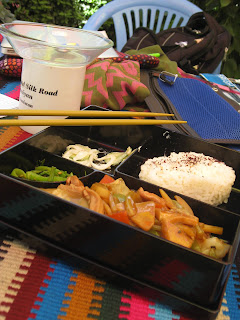
This restaurant, like every place that caters to the international set, is completely unmarked outside. A friend of a friend told us to look for the orange door just across the street from our guesthouse, and surely enough there was a rose-garden cafe and local handicrafts shop tucked behind it. Staff in the guesthouse pointed us to the coffeeshop just a few steps further down the street. Another expat's dining guide provides plenty of recommendations and helpful directions to each.
Thankfully, there's also a private taxi service (or three) that serve the foreigners as well - the dispatcher answers in English, and the drivers know all the usual hangouts, including many private houses, by name. (This is exceedingly helpful in a city where building numbers are rare and not all streets are named). For $4, they'll drop you off at the unmarked door of your choice, in their equally unmarked Corollas.
Then it's a matter of knocking and stepping into a small alcove to be searched. Afreen draws curious looks from the guards who check her backpack - Afghans aren't allowed in many of these places, so she looks suspicious until beginning to speak. Bags approved, the armed guards open a second door into a world completely removed from any exterior reality. The Taverna du Liban has a four-foot tall brass teapot decorating one corner and serves hookah; the Gandamack Lodge contains a reasonable approximation of a British pub, with the exception of the official government permit requesting that they not serve alcohol to "Afghan citizens or muslims" and a very American "Mad River Glen: ski it if you can" sticker over the bar.
This second, secretive Kabul provides escape from the chaos and possible threats found in the first. Still, its isolation from the greater city is total, and it would be quite easy to live here and never interact with a local except to order dinner. At the end of a day in my office, where I am the only foreigner in the building and one of a mere handful in the organization, it is strange to return to a world my colleagues simply don't know. I eat cafeteria Afghan lunches and participate in spirited half-translated discussions on politics, world affairs, and comparative sociology, only to vanish back into home comforts and English in these separate evening spaces. My desire to escape the speakeasy-bubble is kept in check by uncertainty, however - in an unfamiliar place, who am I to break with habit and test the risks? It's a deeply restrictive little world, and yet it is comfortably so.

Subscribe to:
Posts (Atom)
