Monday, July 5, 2010
Traveling again
So it turns out I'll be leaving very early tomorrow morning for a short trip out of Kabul. Updates will almost certainly be reduced while I'm gone - look for my next post to be from Bamiyan!


Wonkery, continued
To recap: the Afghan election system is both simple and screwy, with straightforward rules that can produce counter-intuitive (and possibly counter-the-public-will) outcomes. At least it makes voting easy, right?
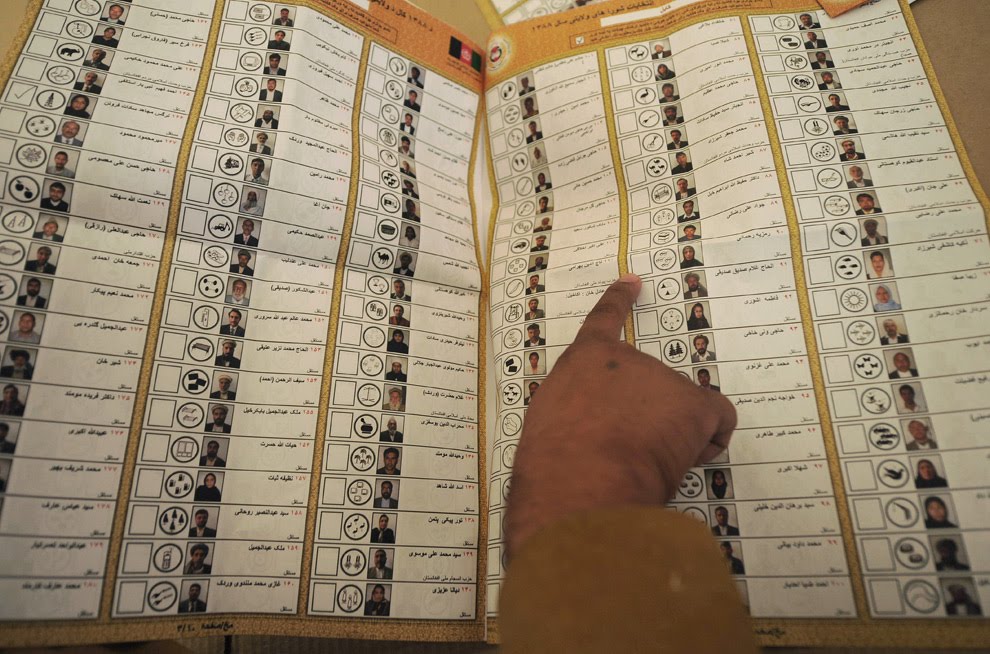
Well...first, imagine a ballot several pages long. At least in Kabul (664 candidates) or Nangarhar (160 candidates), and probably also Kandahar (50 candidates), the list simply doesn't fit on a single page. Thankfully, the ballot order lottery takes place when the final candidate list is released, months before the election. Ballot order numbers appear on most campaign posters to simplify the process of finding the right name on election day.

(A ballot for last year's provincial council race in Kabul - courtesy of Shah Marai/AFP/Getty Images)
Next, imagine you have to find your candidate without being able to read. The most recent estimate in the CIA World Factbook gives Afghanistan a 28.1% literacy rate. As a result, the ballot paper includes not only a candidate's name but also a photograph and a small symbol, which also appears on campaign posters and other materials as a way of branding the candidate with the image.
For fairness's sake, the symbols are all provided by the Independent Election Commission and are distributed in a lottery system akin to the one that determines ballot order. They are relatively ordinary objects - apples, airplanes, butterflies and books all appear. It's an ingenious system for managing candidate identification in the face of high illiteracy, all in all.

vote for this lovely young woman - look for the desk
The symbols do have their flaws, though. The most obvious is that there aren't enough distinct objects, so a candidate symbolized by one cherry is running against a candidate symbolized by two cherries, and possibly another with three. This muddles their clarity somewhat and provides another necessary element for voters to remember (unless the candidate photographs then help make the final distinction).
What's more, candidates are assigned new symbols at each election. If you ran for a parliamentary seat as an ear of corn and lost, this time you might be running as a bicycle. Incumbents, too, have to re-brand themselves with the symbol of the cycle, which might be hard enough given the completely apolitical nature of most of these images, but which takes on new challenges when the symbol I use today belonged to a very different candidate in, say, last year's district council race. Because these images serve to identify candidates among an electorate who can't read, it's almost like running under a different name each elections, at least in some parts of the country.
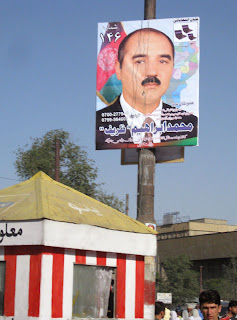
this guy must be worth a vote - he's got three laptops!
Alrighty, if you've borne with me thus far, you've got a pretty good idea of the electoral mechanics in place. I'll try and move into political intrigue and current events as campaign season heats up. There have been some episodes of violence surrounding rallies already, and there's something of a legal debate underway as to whether or not it was correct to remove 32 candidates from the voter rolls after the final list was published or not (okay, so that story will also involve more electoral management office introductions). Anyway, for now I'm off to finish up work and head to a wedding, so my next post will almost assuredly be more colorful.
Well...first, imagine a ballot several pages long. At least in Kabul (664 candidates) or Nangarhar (160 candidates), and probably also Kandahar (50 candidates), the list simply doesn't fit on a single page. Thankfully, the ballot order lottery takes place when the final candidate list is released, months before the election. Ballot order numbers appear on most campaign posters to simplify the process of finding the right name on election day.
(A ballot for last year's provincial council race in Kabul - courtesy of Shah Marai/AFP/Getty Images)
Next, imagine you have to find your candidate without being able to read. The most recent estimate in the CIA World Factbook gives Afghanistan a 28.1% literacy rate. As a result, the ballot paper includes not only a candidate's name but also a photograph and a small symbol, which also appears on campaign posters and other materials as a way of branding the candidate with the image.
For fairness's sake, the symbols are all provided by the Independent Election Commission and are distributed in a lottery system akin to the one that determines ballot order. They are relatively ordinary objects - apples, airplanes, butterflies and books all appear. It's an ingenious system for managing candidate identification in the face of high illiteracy, all in all.

vote for this lovely young woman - look for the desk
The symbols do have their flaws, though. The most obvious is that there aren't enough distinct objects, so a candidate symbolized by one cherry is running against a candidate symbolized by two cherries, and possibly another with three. This muddles their clarity somewhat and provides another necessary element for voters to remember (unless the candidate photographs then help make the final distinction).
What's more, candidates are assigned new symbols at each election. If you ran for a parliamentary seat as an ear of corn and lost, this time you might be running as a bicycle. Incumbents, too, have to re-brand themselves with the symbol of the cycle, which might be hard enough given the completely apolitical nature of most of these images, but which takes on new challenges when the symbol I use today belonged to a very different candidate in, say, last year's district council race. Because these images serve to identify candidates among an electorate who can't read, it's almost like running under a different name each elections, at least in some parts of the country.

this guy must be worth a vote - he's got three laptops!
Alrighty, if you've borne with me thus far, you've got a pretty good idea of the electoral mechanics in place. I'll try and move into political intrigue and current events as campaign season heats up. There have been some episodes of violence surrounding rallies already, and there's something of a legal debate underway as to whether or not it was correct to remove 32 candidates from the voter rolls after the final list was published or not (okay, so that story will also involve more electoral management office introductions). Anyway, for now I'm off to finish up work and head to a wedding, so my next post will almost assuredly be more colorful.
Sunday, July 4, 2010
Soccer-riot diplomacy
The World Cup goes on in Kabul as it does elsewhere - though people here watch with less public passion than my friends in Accra or even Dhaka describe, I did nearly get into a traffic accident riding with a driver too distracted by Spain versus Switzerland to watch the road. However, the pundits' favorite sporting event (well, possibly second to the Olympics) should not go unmentioned on a blog devoted to armchair diplomacy, and so I offer my thanks to my friend SV for this guest post:
It’s a staple of the Cold War-era sports drama—a cheap shot by the villain. The East German hockey player who hacks the Minnesota farmboy’s knee on a breakaway play. The Soviet boxer who rabbit punches the Philadelphia southpaw after the bell. The Chinese martial artist who blinds the square-jawed Yankee soldier with quicklime powder in the final round of the kumite. Yet the fair player overcomes treachery for the win, mooting the more interesting question.
The limited diplomatic value of this metaphor has always been the same—that the hero can afford not merely to be just, and deliver a proportional response. But further, drawing on greater personal resource and greater strength of will, can afford to do more than win: to win cleanly and indisputably. To avoid, at all costs, the messier work of protest and diplomacy within a body of laws that may well turn out imperfect.
Nowhere is this limitation clearer today than in the public profile of Uruguayan striker Luis Suárez, who catalyzed his nation’s first FIFA World Cup semifinal berth in forty years—at the expense of Ghana’s (and, indeed, Africa’s) first semifinal berth ever. In the closing moments of the quarterfinal, Suárez committed a handball block of Ghana’s point blank header on an open net. Though Suárez drew an immediate red card to leave the game, Asamoah Gyan of Ghana then missed the penalty kick, hitting the crossbar and taking the drawn match to a shootout. Uruguay won 4-2.
The prompt and shrill response to the “Hand of Suárez” and his standard one-game disqualification (meaning he could return for the final if Uruguay defeats the Netherlands) has been indignant. John Leicester’s AP editorial pretty well sums up the sentiment: FIFA should have banned him from the entire tournament, run him out of Johannesburg on a rail, and so on.
As with any system of many variables, what made this fiasco illustrative were the many that were controlled for. The score was tied 1-1. There was no time left in regulation-plus-stoppage for any subsequent plays. Both nations had finished second in their respective group stage matches, then defeated first seeds by 2-1 to reach the quarterfinal. The winning scorer in Uruguay-Korea had been Suárez; in Ghana-U.S., Gyan. The clearly-superior-hero narrative was as inapt as the David-and-Goliath. Because the teams were so well matched, any breach could, indeed, decide the outcome. Thus, there was no principled way to tell hero from villain, only by picking a gut-satisfying outcome and working backwards.
Under the circumstances, then, Suárez excelled as both a tactician and a strategist. Leicester himself admits (which is to say, accuses) that Suárez took a calculated risk, choosing to violate the most elemental law of the game and face swift and certain punishment rather than concede immutable defeat. He put his trust in the settled rule-punishment calculus, accepting the prescribed one-game disqualification. And he put his trust in his teammates, who took the opportunity to rally and win. What he didn’t do was go quietly into the night.
For its part, FIFA did well not to extend the disqualification to the finals as an act of deterrence, smacking as it would have of moving the goal-posts after the fact. Where any political decision will be decried anyway, simple expediency leads (ironically enough) back to principled application of the rules.
There is some weight to the counterargument that Ghana had the last clear chance and still blew it. More fundamentally, though, the animus against Suárez is that it was Ghana’s turn to win, that the rules of zero-sum diplomacy are simply not enough to right that injustice. And that’s the crazy part of the argument. There aren’t any turns.

(Chile versus Switzerland at the Kabul Health Club)
Saturday, July 3, 2010
SNTV - how we got here
After my episode wonking out, the natural question from those who tolerate my professorial mode was "well, how did such a system come into place?"
The single, non-transferable vote (SNTV) was implemented in the 2004 election law. At the time, the apparent benefits were that 1) it's easy to vote (there's really nothing simpler than checking the box for an individual candidate), 2) it's easy to count (same), and 3) province-wide districts minimize the distortion effect of population-guessing in the absence of a complete census.

Finally, it discourages the formation of strong political parties. The Afghan Constitution bans all political parties formed around ethnic, linguistic, regional or religious ties (which is to say, the most natural fractures) in the hope that the central government can function as a unifying, rather than dividing, force. Selecting an election system that discourages party formation extends this goal.
The irony, then, is that by producing a relatively unpredictable parliament (and by leaving the parliament constitutionally weak to begin with), this greatly raises the stakes for presidential elections, where only one candidate can win the office.
War rugs
On my very first day in Kabul, I saw a carpet for sale at the Serena Hotel gift shop that struck me as gaudy and comic: a knotted depiction of tanks and grenades carefully labeled in English. I assumed it was some kind of touristy nonsense and dismissed it.
Tagging along with carpet-shopping friends yesterday, I learned that not only is that (admittedly kitschy example) a relatively common souvenir, it's also part of a far richer history of war rugs dating to the 1980s. Until recently, there was a War Rug gallery in New York, and even a show in Chelsea. There's even a Rugs of War blog.
Soviet-era war rugs have become rather valuable artifacts as both art and anthropology, and the tradition has continued in styles both weirdly beautiful and frightfully tacky. Some samples I saw yesterday (please forgive the photos; the thought of writing about these didn't occur to me until later, so I didn't even attempt to take blog-worthy pictures).

A Soviet-period rug Natalie put on hold; this carpet's war imagery is subtle - the pattern in the center is Kalashnikovs shooting at snakes, and yet the design is symmetrical and not particularly violent.

A modern rug detailing various weapons in surprising detail.

Another less-obvious war rug, this a recent sample - the pattern is of urban life, with roads and buildings, but also helicopters and tanks running along the lower border, just outside the city.

And the blatant - 9/11 and the "war on terror", woven by someone who clearly reversed the pattern (enlarge the image and you'll see the English labels are all backwards).
Thursday, July 1, 2010
Photos for the day


Call today's pictures "a view from TV mountain" - while most of Kabul sits in a valley, one large hill is perched in the middle of the city. On days when traffic is too backed-up along the main road between my home and office, Hossein goes up and over the hill instead. Under the many antennas and communications towers that give TV Mountain its name, life goes on normally, if a bit more vertically. (and yes, that's a cemetery in the foreground of the lower photo).
Stepping back
Today, news outside of Afghanistan deserves mention. A brief roundup:
One of the accused Russian spies was a Kennedy School mid-career MPA in the same class as Felipe Calderón. Bets are already underway as to which member of the MPP '11 class is most likely to be arrested in similar fashion ten years hence.
Also, a friend of mine coordinated a research project combing the major newspapers' coverage of waterboarding. Their report, released by the Shorenstein Center, has picked up significant press in the blogosphere: Glenn Greenwald, Andrew Sullivan, and the Huffington Post all wrote about it yesterday. Having read a few early drafts, I'm very proud to see it make an impact.
Finally, more locally, a UN driver was killed in Kabul on Tuesday. There are no official reports yet, but rumor here was that it was a mistake rather than an attack, and I'm not sure which outcome is more worrisome. In either case, it's a tragedy.
Subscribe to:
Posts (Atom)
