Showing posts with label elections. Show all posts

Monday, July 26, 2010

Candidate killed in Khost

The explosion at a campaign rally I linked to on Saturday killed the candidate, Maulvi Saeedullah Saeed. Another candidate, Najibullah Gulistani of Ghazni province, became the second politician abducted by the Taliban this cycle. As elections near (scheduled for Saturday, September 18, they are now less than eight weeks away), expect increasing attacks and disruptions.


Even when violence doesn't mar the competition, the campaign season manages plenty of drama. One male candidate spoke out against a female opponent by calling her a "scarlet pagan" and warned that she would turn the women of the province to her vices if elected, for example. Reading the American political press, I'm sure I can find statements at least as ludicrous, but the degree to which ad hominem attacks on women are accepted here is troubling.

Sunday, July 25, 2010

Herat: photos for the day


In campaign news, violence against candidates continues: an explosion injured 17 people. Actual Herat travel-blogging and campaign news to follow soon, I promise.

Wednesday, July 21, 2010

Kidnapping candidates

Pajhwok News covers the kidnapping of a parliamentary candidate in Herat province. Arbab Yusuf was campaigning in Gulran district when he was abducted by the Taliban yesterday.

Running for office is a very different game here. Night letters demanding that candidates withdraw (often threatening violence against those who remain in the race) also menace would-be parliamentarians. Women are especially targeted, and the threats often extend to the candidates' families and children. A report from the Free and Fair Elections Foundation details the extent of this intimidation:
Attacks on individuals involved in the electoral process were reported by observers in Badghis, Farah, Helmand, Nangarhar, and Paktika during the challenge period. The attacks, several of them resulting in fatalities, included physical assaults, suicide attacks, and bombings directed at candidates and election workers.
Night letters were reported through direct and indirect observation in 9 provinces, with the general population, election workers, candidates, government employees and Afghan security forces designated as targets. In Zabul, government employees received threatening phone calls warning them not to participate in the electoral process.

When the risks of campaigning include violent death, it's almost natural that the rewards include kick-backs and bribes - salaries for the Wolesi Jirga (the lower house of Parliament and those currently running for election) just aren't high enough to justify running otherwise. It also affects candidates without ties to existing power-brokers disproportionately - for all the messy rounds of candidate vetting, even a perfect process could not eliminate everyone with questionable connections, so those afforded the security of warlord protection run with the additional advantages of armed support.

This certainly isn't the sole reason democracy struggles in Afghanistan, but insecurity is quite possibly the greatest current obstacle to good elections. If you're a praying sort, Arbab Yusuf - and his fellow candidates under siege - could probably use one right now.

Saturday, July 17, 2010

Elections and Illegal Armed Groups, Cont.

The wiser, learned hands of the Afghanistan Analysts Network are following the candidate vetting process I wrote about, and to my surprise, they have almost as much difficulty understanding what's going on as I did.

Thursday, July 15, 2010

Election law, alphabet soup, and illegal armed groups

I began writing about Afghan election management in order to provide some context for when actual campaign stories began to appear. However, the principal actors remain unintroduced even as their decisions have begun to stir controversy.

The Independent Election Commission (IEC) serves as the technocratic body responsible for administering elections. Founded in 2004 as a domestic successor to the Joint Elections Management Body (JEMB), an internationally-run institution, the IEC registers candidates, voters, polling places and election monitors.

The Electoral Complaints Commission (ECC) remains a mixed secretariat, with three Afghan and two international commissioners. It is established under Afghan electoral law as an enforcement body responsible for monitoring and investigating possible violations.


Though chaired by the IEC, the vetting group responsible for reviewing candidate ties to illegal armed groups is a separate (third!) election body. Lists it produces are given to the ECC, which then records the complaints against these candidates and passes them to the IEC for a final decision on inclusion or removal on the voter rolls. Different readings of Article 12 of the Afghan Election Law empower both the ECC and IEC to review or amend these lists, though in practice only the IEC does so.

The work of the two commissions is tightly intertwined, and as we can already see, often confusingly interdependent. Try and follow this one:

On June 22, the IEC released a press statement titled "Publication of final list of candidates for Wolesi Jirga Elections 2010 and commencement of electoral campaign" [PDF] explaining the process by which the preliminary candidate list had been thoroughly reviewed and culled. With regards to possible ties to illegal armed groups, the IEC explained, "It is mentionable that after ECC investigation for the submitted complains for 8 candidates who have been challenged, here IEC provide them the opportunity of 5 working days till 24 June to submit their advocacy documents. As result the final list of (Kabul, Jowzjan, Ghor, Badakhshan, Ghazni and Takhar) provinces will announce until mentioned date. It is worth to mention that if the candidates provide sufficient reasons, they can be included in the final list of WJ elections." [multiply sic]


The candidate lottery completed, symbols assigned and ballot order determined, campaign season officially opened and posters began to crop up overnight.

On June 30, staff at the Free and Fair Elections Foundation of Afghanistan (FEFA) received complaints from a number of candidates who had received notification from the IEC that they were under suspicion of holding ties to illegal armed groups. Each was given 48 hours to travel to Kabul and present documentation signed by three relevant government ministers in order to remain on the candidate list. Given long travel times over Afghan roads and the fact that much of this 48-hour period fell on Friday, this effectively gave the 32 affected candidates no opportunity to respond.

On July 1, FEFA called a stakeholders' meeting to determine why candidates were being threatened with exclusion after the official list had been closed. Because I'm not certain whether the meeting was on or off the record, you'll have to make do with my summary of its findings rather than a complete transcript of the proceedings.


The critical detail revealed in the meeting is that the ECC has to sign off on the IEC's final candidate list before it is legally closed to further amendment. Though this should happen before the ballot-symbol-and-order lotteries, the ECC had not, in fact, given its official approval to the IEC's list as released the week prior. The IEC, in keeping with its official published election schedule, had released the list without this ECC sign-off. The crisis moment then came when, after the IEC's announcement of what we will now call the "final list", the vetting group had handed over to the ECC its fourth list of candidates with ties to illegal armed groups.

(Some back story: the first list consisted of 85 names. With no written procedure in place, the ECC requested that the IEC give each five-day period in which to clear their names via signed letters from the Ministry of the Interior. At the end of the five days, all 85 were able to produce such declarations of innocence, so a second list re-affirmed some of their cases in order to force at least a few from the ballot. This cycle between the vetting commission and the elections commissions continued, such that the fourth list consisted of 16 candidates who had already been accused on lists 1-3 and 16 new names.)


Given that its ballot list was already released, the IEC shortened the response time available for their defense in order to speed the process. In the end, 31 names were removed [PDF] from the ballot on July 7 and a "final, final" list [PDF] came out, with no changes to the lotteries already conducted.

Predictably, this looked like the Commissions joining together to re-open a legally-closed list to evict 16 opposition candidates under the guise of late-breaking discoveries. Yes, there's electoral infrastructure in place, governed by written law. It's just that not even watchdogs like FEFA know each intricacy, and the commissions themselves don't necessarily help clarify. Transparency, comprehensibility, and perceived fairness all have some way to go.

Tuesday, July 13, 2010

Against Postponing Elections

In Sunday's Washington Post, Candace Rondeaux argues for postponing parliamentary elections. Her main points are:
  • Security is still deteriorating
  • Known flaws in the elections process haven't been fixed since last year
  • The international community isn't sufficiently involved


I don't actually take issue with any of these arguments, but I don't think that they add up to postponing the elections...

Security is a huge unknown, and it could just as easily deteriorate as improve over the next six months. If we postpone in the hope of a free campaign environment, we could find ourselves waiting quite some time (at least in certain districts). If the security situation is too bad for elections now, then any postponement would become indefinite.

The elections process is indeed terribly flawed. In explaining the quirks of the voting system, I've only scratched the surface. The process of removing candidates with ties to illegal armed groups functions even more poorly than she described - but given the relevant government ministries' refusal to thoroughly vet would-be parliamentarians, it's near-impossible for outside bodies to even begin researching all 2500 candidates. The institutions we helped form are opaque and dysfunctional, but we're losing leverage to reform them. This is a question worth addressing, but unless we can spell out a new framework for electoral management, halting campaigns already underway hurts many legitimate candidates without changing the underlying deficiencies.


Finally, the international community is deliberate in its distance. In the presidential election, their involvement was able to highlight flaws without being able to prevent fraud or solve the crisis. Again, without the leverage to change how these elections are carried out, the international community is quite possibly better off not associating itself with the process. But the solution still shouldn't be postponement or cancellation now that campaigns are underway, candidates are already printing posters and hosting rallies and spending both their hard-raised funds and taking well-calculated risks. An election clearly stolen by supporters of the president would be a disaster, but a suspension of elections could create just as much public disillusionment.

The solution, such as it is, should be harder behind-the-scenes work for effective administration, combined with a highly concerted effort to ensure election-day security and plenty of training and support for organizations like the Free and Fair Elections Foundation and the Commission, who are playing an active advocacy role. Elections are much harder to carry out here, due not only to security and administration but also because of questions of media, geography, and the near-total loss of social trust over years of conflict.

The word "solution" makes these problems sound addressable, though some of them may not be. But we've begun holding elections here and to halt this one step towards democratic governance doesn't even begin to fix all these other issues - it's just a concrete action that feels like a solution in the face of a tangle of challenges too complex for any easy proposals.

Monday, July 5, 2010

Wonkery, continued

To recap: the Afghan election system is both simple and screwy, with straightforward rules that can produce counter-intuitive (and possibly counter-the-public-will) outcomes. At least it makes voting easy, right?

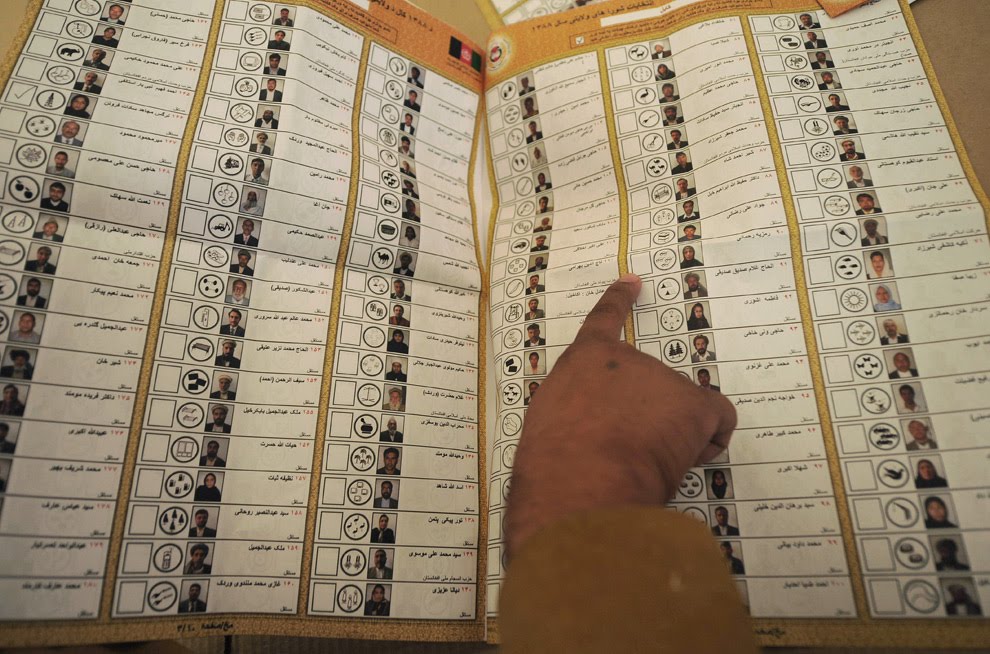
Well...first, imagine a ballot several pages long. At least in Kabul (664 candidates) or Nangarhar (160 candidates), and probably also Kandahar (50 candidates), the list simply doesn't fit on a single page. Thankfully, the ballot order lottery takes place when the final candidate list is released, months before the election. Ballot order numbers appear on most campaign posters to simplify the process of finding the right name on election day.


(A ballot for last year's provincial council race in Kabul - courtesy of Shah Marai/AFP/Getty Images)

Next, imagine you have to find your candidate without being able to read. The most recent estimate in the CIA World Factbook gives Afghanistan a 28.1% literacy rate. As a result, the ballot paper includes not only a candidate's name but also a photograph and a small symbol, which also appears on campaign posters and other materials as a way of branding the candidate with the image.

For fairness's sake, the symbols are all provided by the Independent Election Commission and are distributed in a lottery system akin to the one that determines ballot order. They are relatively ordinary objects - apples, airplanes, butterflies and books all appear. It's an ingenious system for managing candidate identification in the face of high illiteracy, all in all.


vote for this lovely young woman - look for the desk

The symbols do have their flaws, though. The most obvious is that there aren't enough distinct objects, so a candidate symbolized by one cherry is running against a candidate symbolized by two cherries, and possibly another with three. This muddles their clarity somewhat and provides another necessary element for voters to remember (unless the candidate photographs then help make the final distinction).

What's more, candidates are assigned new symbols at each election. If you ran for a parliamentary seat as an ear of corn and lost, this time you might be running as a bicycle. Incumbents, too, have to re-brand themselves with the symbol of the cycle, which might be hard enough given the completely apolitical nature of most of these images, but which takes on new challenges when the symbol I use today belonged to a very different candidate in, say, last year's district council race. Because these images serve to identify candidates among an electorate who can't read, it's almost like running under a different name each elections, at least in some parts of the country.


this guy must be worth a vote - he's got three laptops!

Alrighty, if you've borne with me thus far, you've got a pretty good idea of the electoral mechanics in place. I'll try and move into political intrigue and current events as campaign season heats up. There have been some episodes of violence surrounding rallies already, and there's something of a legal debate underway as to whether or not it was correct to remove 32 candidates from the voter rolls after the final list was published or not (okay, so that story will also involve more electoral management office introductions). Anyway, for now I'm off to finish up work and head to a wedding, so my next post will almost assuredly be more colorful.

Saturday, July 3, 2010

SNTV - how we got here

After my episode wonking out, the natural question from those who tolerate my professorial mode was "well, how did such a system come into place?"

The single, non-transferable vote (SNTV) was implemented in the 2004 election law. At the time, the apparent benefits were that 1) it's easy to vote (there's really nothing simpler than checking the box for an individual candidate), 2) it's easy to count (same), and 3) province-wide districts minimize the distortion effect of population-guessing in the absence of a complete census.


Finally, it discourages the formation of strong political parties. The Afghan Constitution bans all political parties formed around ethnic, linguistic, regional or religious ties (which is to say, the most natural fractures) in the hope that the central government can function as a unifying, rather than dividing, force. Selecting an election system that discourages party formation extends this goal.

The irony, then, is that by producing a relatively unpredictable parliament (and by leaving the parliament constitutionally weak to begin with), this greatly raises the stakes for presidential elections, where only one candidate can win the office.

Wednesday, June 30, 2010

Wonking out

Campaign season officially opened a few days ago, but the initial trickle of small candidate posters exploded into a forest of billboards just last night. Demazang Circle near my office had only one campaign advertisement yesterday; this morning there were five.


The art of political messaging is still pretty simple here - the pattern across the posters and billboards I've seen is candidate photo + name + party affiliation (99% say "independent") + ballot order + ballot symbol. Some include a slogan, but many do not. The name of the game seems to be simple recognition, which is logical enough given that there are over 600 candidates running for 33 open and 9 women's seats in Kabul province.

As the title indicates, this post exists solely to indulge my own interest in the technicalities of the election process. If voting systems bore you, please feel free to skim the photos and move along... but actually, the Afghan electoral system's quirks make for more compelling reading than you might otherwise guess.


As mentioned above, there are over 600 total candidates running for 42 seats across the whole of Kabul province (estimated population 4 million). Unlike U.S. House districts, though, the province is not subdivided into single-member districts - all 42 will be elected at-large from the province. What's more, each voter can choose only one candidate on his or her ballot. As a resident of Kabul, therefore, I get a say in only one of the 42 people who will represent me - and with hundreds of choices, the probability that the person I select will lose is quite high. The system is called the single, non-transferable vote (SNTV), and while it's simple enough to use, it's incredibly strategically complicated for both candidates and voters to navigate.


First, from a voter perspective, it's very important to choose my candidate carefully. If I vote for someone who's already very popular, I waste my voice on a shoo-in; but if I choose a nobody running in 643rd place, I waste my ballot on a hopeless cause. The trick is to vote for my preferred candidate from among the middle of the pack, hoping to nudge someone from 43rd place into 39th - even if this person is perhaps only my 3rd choice - these are the seats are decided by a tiny number of votes. The fun part is that there's no polling information, so even guessing which candidates are safe and which are competitive is a game of information-gathering.

Adding to the fun, the Afghan Constitution sets aside a fixed number of seats for women, but does not hold a separate election for these seats. When the votes are counted, the top 9 women will receive seats, even if the 9th is actually in 253rd place. Perversely, this reduces the incentive to vote for a female candidate, because the electoral bar is so much more easily cleared.


From a candidate perspective, if I want to form a political party around my shared views with others in the race, it's incredibly difficult to do so. If some few of us were to band together on a common platform and pool our efforts to gain votes over the other several hundred, we'd need first to guess at how many supporters would back our group, then nominate exactly the right number of candidates to take advantage of that voting pool - too many, and our votes get divided too thin and we win no seats. Too few, and all our candidates win, but we'll have sacrificed additional seats we could have gotten. Then we have to work to divide our supporters' votes evenly among the candidates (in Taiwan, back when SNTV was in use there, political parties would print ads telling supporters which candidate to vote for based on their birthday - their politicians split the vote into calendar-segments).

In reality, what happens is that political parties don't really form, and the provinces break into small parochial constituencies rather than uniting behind more national platforms. Single, non-transferable voting systems are rare enough, and watching elections play out here, it's easy to see why.

Coming soon: a related post on adapting campaigning and balloting for a country with a low literacy rate, translating campaign billboards, and other elections fun.

Saturday, March 29, 2008

Free and fair, not so much

Okay, so I know just enough history to have already been skeptical about genuine elections in Zimbabwe, but the Sokwanele blog is posting an interactive map to illustrate just how many obstacles stand between today's vote and true democracy. Oh, and Foreign Policy points out that there are 3 million extra ballots just waiting for abuse.

Election-watching

Okay, so Pennsylvania doesn't vote until April 22 and we're all sick of replayed Wright sermons and Bosnia footage. In Zimbabwe, on the other hand, the big vote is tomorrow and the result could range from violent to jubilant. I find myself skeptical that Mugabe will ever leave willingly, but I'll take whatever glimmer of hope I can cling to.

Here's to watching results come in from Harare.

Thursday, September 6, 2007

Elections!

A good primer on Friday's voting available at Slate: "Why do so few Moroccans use their vote?"

Thursday, July 5, 2007

Democracy again: Talking about Reform

The leaving-Fes update: one week and counting...eek! As regards my imminent departure, I'm past denial and into bargaining - pray, knock on wood, cross your fingers or do whatever you do on Monday for me as I MIGHT have found a way to come back. For now, it's back to democracy and security.

Part Two: The First Dialogue
Saturday morning we broke into small groups (about 16 people each) for discussion sessions. The first hour and a half was devoted to "democratic reform in Morocco," a chance to define democratic ideals and look at how such a government might work here, as well as the US role in promoting democracy.

My notes:
-Power in the hands of popularly elected leaders
-Talk of a constitution - but what about the fact that kings have ruled for centuries (need for GRADUAL change)
-Introduction of checks and balances? Increase accountability
-Reform Parliament FIRST
-Opening of media

The idea that any change will happen very slowly was immediately evident. The king is not universally loved (see nickname "sa ma-jet-ski"), but the Parliament doesn't exactly have anyone's trust either. Mohammed VI has reformed things (women's rights, for example) and is sometimes seen as less self-interested than elected representatives. In addition to holding all political power, he's also a direct descendent of the Prophet and is the leader of the faithful in Morocco. Almost no one wants to depose him, and very few want to relegate him to entirely ceremonial status. The most common proposal looks like a modified American system in which the king would be the executive, with real power but also checks and accountability (no Bush jokes, please).

This devolved into a complaints session about the uselessness of the current elected officials, particularly the PJD. They aren't islamist because explicitly religious parties banned, but they still campaign to a conservative religious base and is more locally active than other parties, particularly in rural areas. One participant described it, "They go into the villages and give a big donation to the mosque at Eid and that's why people vote for them, because they don't read the platforms and don't know better." My notes at this point, "well, so do Republicans."

The educated urban Moroccans are definitely afraid of this success and their response is generally to point to the PJD and the 40+% illiteracy rate as evidence that real democracy won't work until the population as a whole is better educated and able to vote on real issues rather than responding to simple pandering. I kept wanting to point out that in the US we have an educated populace and we still tend to elect the taller candidate - and that "elections on issues alone" is utopian pie-in-the-sky dreaming - if you wait for the perfect democracy you'll never get one at all. Don't worry, I mostly kept my jaded sarcasm to myself, or at least my notes.

The main buzzwords we kept returning to were inclusiveness and accountability. Part of why the PJD is popular in rural areas is that many other parties don't bother to campaign there. Youth involvement is distressingly low (sound familiar?), while women's outreach sections tend to be more show than substance. Government business is often conducted in French, which half the country doesn't speak, or Arabic, which still isn't universal (a significant percentage, particularly in rural areas, speak Tamazigh). Elected representatives don't have the will or the money to return to their constituencies regularly, or they win the seat and its salary but never even bother to show up in Rabat. Because the king often steps in and takes the rein on controversial questions, there's little incentive for compromise between the parties, who fight until Mohammed VI picks a side and resolves the conflict.

A moderator reminded us that we couldn't just list problems and obstacles, that we were supposed to propose solutions, and we began brainstorming. Our suggestions (with my added commentary) were:

The Moroccan government should promote the creation of local, organic news media (such as community radio programming) in local languages. (Maybe if the people know what's happening in Rabat, they'll be more inclined to respond).

Morocco should relax press restrictions so as to allow for greater dissent (censorship is still a problem if you want to criticize the king, for example)

The Moroccan Parliament should stress accountability through a program tracking members voting records, a written code of legislator conduct and the creation of contracts between individual representatives and their constituencies. It should also tie salary to attendance and consider the creation of an accountability committee to propose further reforms.

US democracy-promotion efforts should cooperate with international partners and create clear objectives for local organizations and individual participation in order to encourage accountability, track actual progress, and create a self-sustaning system.

Monday, July 2, 2007

Democracy in Morocco: the Rabat Panels

Even before the now-finally-blogged trip to Marrakech, I attended a "Moroccan-American Youth Dialogue on Democracy and Security" in Rabat. The conference made both Al-Jazeera and the BBC, and a comment of mine even made it into the final BBC Radio edit (yes, a Katy in international news - I could get used to this...) However, I didn't write about it at first because I wanted concrete ideas on the topic first. Then I didn't write about it because there was a shiny music festival in town and stalking rock stars was more fun anyway. Last weekend, a second conference brought some of those same discussions back to Fes and I still didn't write about it because the whole topic depresses me.

Democracy in Morocco is a pesky, messy question and American democracy promotion a more complicated issue still. And truth be told, I'm not sure that very many people involved in Moroccan or American politics really care if Morocco ever democratizes. Still, it's an interesting case study in American foreign relations and Middle Eastern politics both domestic and international, so here goes...

Part One: the Players

Day One of the conference involved a series of discussion panels representing many of the interested parties. Ali Amar, publisher of the government-critical magazine Le Journal Hebdomadaire, skipped out at the last minute, but Yassir Mezouari represented the Youth section of the USFP (socialist) party, while Lahcen Haddad spoke for the Mouvement Populaire party. Mezouari went on about the need for greater youth involvement in politics and lamented his generation's disinterest (sound familiar?) Haddad described a society in need of greater education and economic stability in order for democracy to flourish, worrying that the present population, impoverished and half-illiterate, is too susceptible to manipulation.

A second panel included Julia Demichelis of USAID and Eric Duhaime of the National Democratic Institute, who discussed the how of American democracy promotion in places like Morocco. Ms. Demichelis was my favorite of the participants, describing parliamentarian education courses in proper legislative etiquette and the creation of a governmental documents library to store and catalog the activities of the legislature. Mr. Duhaime added that the NDI works with a number of local and national organizations, including offering GOTV training to Moroccan political parties (I want THAT job!)

The final group of speakers went off the record because Craig Karp, the political affairs counselor to the US Ambassador to Morocco, did not want his remarks broadcast on Al-Jazeera. I was nonetheless disappointed when he followed his "off the record" request with a presentation carefully crafted and absolutely correct - if you're going to go off the record you might as well enjoy the opportunity to be frank! Mohammed Ben Hammou followed him with insightful remarks I've since forgotten, which is a shame.

We ended the discussion panels with dinner and a free evening to mull over all we'd heard in preparation for the next day's discussions.