Tuesday, June 29, 2010
Adventures in Bamiyan
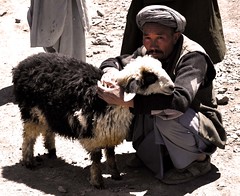
With any luck, I'll be traveling this weekend to Bamiyan province, home of Afghanistan's only female governor, two empty niches where gigantic Buddha statues stood until Taliban forces destroyed them, and a series of deep turquoise lakes called Band-e-Amir. While mine will be a short tourist's visit, however, my friend Afreen has been in Bamiyan for two weeks touring schools and development projects in villages far outside the provincial capital. Reading her account of local hospitality has made me sad that I won't be staying longer myself - I don't imagine I'll be on the receiving end of a sheep here in Kabul.


Monday, June 28, 2010
Photos for the day


Many of the trucks found hauling goods about Kabul are intricately decorated - these are just two samples of the many detailed paint jobs I've seen. I have no idea why anyone goes to this level of effort (the work appears to be hand-done), nor how it's become so widely popular.
Afghan Model
This morning, a colleague from the logistics section wandered in to my office carrying two scrapbooks. He addressed Wakeel, who then translated as he placed one of the albums in my hands: "these are photographs of his son, in traditional Afghan clothes."
The first few were postcard-like prints, each featuring several different outfits and printed with "Maseeh Ur Rahman Popalzai," the name of our young model. Later photographs show him posed in a rose garden; petting a goat; holding a shovel over his shoulder in front of a display of summer wheat; and endless close-ups of a serious face with an even more serious handlebar mustache.

He is wearing clothes from all over Afghanistan, and as I thumb through the pages, my colleague provides narration: "Herat... Kandahar... Kabul." Wakeel explains that Maseeh Rahman competed on a television show called Afghan Model - then corrects himself - he won Afghan Model. The second scrapbook, it turns out, is a collection of congratulations. I am asked to contribute, so I pen a brief note and sign my name. After prompting me to add "USA" next to my entry, the man asks me if I have a photograph of myself. Surely enough, it appears that most of these fan messages are accompanied by passport-sized images.
We made a deal - I'll bring a photo tomorrow for the fan book, and I get copies of a couple of the postcard photos in exchange. Handlebar mustaches are far from dreamy in my book, but I can't pass up this kind of brush with fame...
The first few were postcard-like prints, each featuring several different outfits and printed with "Maseeh Ur Rahman Popalzai," the name of our young model. Later photographs show him posed in a rose garden; petting a goat; holding a shovel over his shoulder in front of a display of summer wheat; and endless close-ups of a serious face with an even more serious handlebar mustache.
He is wearing clothes from all over Afghanistan, and as I thumb through the pages, my colleague provides narration: "Herat... Kandahar... Kabul." Wakeel explains that Maseeh Rahman competed on a television show called Afghan Model - then corrects himself - he won Afghan Model. The second scrapbook, it turns out, is a collection of congratulations. I am asked to contribute, so I pen a brief note and sign my name. After prompting me to add "USA" next to my entry, the man asks me if I have a photograph of myself. Surely enough, it appears that most of these fan messages are accompanied by passport-sized images.
We made a deal - I'll bring a photo tomorrow for the fan book, and I get copies of a couple of the postcard photos in exchange. Handlebar mustaches are far from dreamy in my book, but I can't pass up this kind of brush with fame...
Saturday, June 26, 2010
A photo for the day

I think I like posting pictures individually - it's much simpler to pick one for the day than to prepare a full album (also, it means more new things for the handful of people I know are checking in regularly). Thoughts?
This one amuses me doubly - first, it was taken on a paved (!) street in a quiet neighborhood of wealthy residences and NGO offices in Karte Se - not where I usually see goatherders. Secondly, there really is a Kabul Fried Chicken, which has seen fit to appropriate the image of Colonel Sanders on its storefront (I've yet to get a photo of that; apologies). Strangely, the name isn't actually translated into Dari underneath - just transliterated. "Kabul Fraid Chikn" - Happy Saturday!
"Something that we've lost"
"I was standing on a busy interjunction in New Delhi with the traffic and the din and the scooters and the bikes and the elephants and the cows, and I remember thinking: These people have got something that we’ve lost. Our traffic rules and sanitation and systems make life easier and more convenient, ensure longer lifespans and perhaps a fairer society. But these things come at a cost, and the cost is what I felt there. There’s a velocity and density of life there that you don’t get in the West, and that I found oxygenating."
--David Mitchell
First, I love this quote. There is a certain heightening of the senses sparked by the seemingly patternless hubbub found in poor, distant cities. Without familiar rules and structures, life flows along according to some complex, unwritten code entirely alien to foreign spectators; and so we stand mutely appreciative of the colors and the sounds and feel all the more alive for the experience. I certainly fell under that spell on my first visit to old-city Fes.
And yet, with "velocity and density..." Mitchell also turns this exotic, romanticised image into a critique of modern conveniences that are only tangential to the chaos he finds so beautiful. Traffic rules eliminate some of the din and the bustle, but they aren't the reason our roads back home don't have elephants or cows. The character of a new place comes from much deeper factors than the presence or absence of sanitation systems, after all. For all that I loved the Coca-Cola donkey, I was more than happy to return to the world of air conditioning when I got back to the States. The moments of wonder I find here are not at things lost in the course of Western progress - they are from a cultural history we simply never had.
While I'm still finding plenty to love about Kabul, I'm less charmed by its quirks than I was by Fes. Part of this is the lack of novelty (the traffic in Kabul was "predictably anarchic," according to my initial impressions), and part of it is that the unfamiliarities of life here come with a vague foreboding that you are in a place where the knowledge you haven't got, if you had it, could save you. Though after a month of watching and listening and settling in, I don't feel this threat as explicitly, it made the introduction less magical.
A friend once noted, "whether one is a returning child of the motherland or a nascent orientophile, there is little that sums up the difference in residential comforts, east by west, as the utter utterness of the power going out... in this regard, the municipal electric grid is indistinguishable from rain, or wind, or any force of nature whose fundamental uncertainty is irreconcilable except by améliean finger-crossing." Despite the beauty of traditional Persian calligraphy, despite the warm hospitality extended to me, despite the small joy of watching the schoolgirls clump around the ice-cream men each afternoon in their black uniforms and white scarves, ordinary life here requires much greater effort than at home. The power is more consistent than I'd have predicted, but taking a morning shower involves a trip out into the garden to plug in the water pump so as to build up adequate pressure, then another trip ten minutes later to unplug it before the overflow floods the roses. Laundry is a two-buckets-in-the-bathtub affair, and while by now I'm fairly adept at this, whatever I came here seeking is not going to be found in my Friday washing routine.
I believe it's possible to embrace the traffic and the din without mourning the ease and convenience of home. At least, I'm trying to strike that balance here: there is much to love about life in Afghanistan, from the dry walnut bars Wakeel just brought in to go with our morning tea to the proliferation of glittery headscarves I see on the street and the implicit hope I find in outlandish fashions here. I don't intend to celebrate the poverty or the inconveniences, however, as my wildest hopes entail retaining the unique and the beautiful of this place even as traffic rules and washing machines invade. Whatever their cost, it's certainly not too high.
Friday, June 25, 2010
A photo for the day

In honor of watermelon season, which is in full swing here. Watermelon juice might just be my new favorite beverage...
Thursday, June 24, 2010

Subscribe to:
Posts (Atom)
