Wednesday, June 30, 2010

Wonking out

Campaign season officially opened a few days ago, but the initial trickle of small candidate posters exploded into a forest of billboards just last night. Demazang Circle near my office had only one campaign advertisement yesterday; this morning there were five.


The art of political messaging is still pretty simple here - the pattern across the posters and billboards I've seen is candidate photo + name + party affiliation (99% say "independent") + ballot order + ballot symbol. Some include a slogan, but many do not. The name of the game seems to be simple recognition, which is logical enough given that there are over 600 candidates running for 33 open and 9 women's seats in Kabul province.

As the title indicates, this post exists solely to indulge my own interest in the technicalities of the election process. If voting systems bore you, please feel free to skim the photos and move along... but actually, the Afghan electoral system's quirks make for more compelling reading than you might otherwise guess.


As mentioned above, there are over 600 total candidates running for 42 seats across the whole of Kabul province (estimated population 4 million). Unlike U.S. House districts, though, the province is not subdivided into single-member districts - all 42 will be elected at-large from the province. What's more, each voter can choose only one candidate on his or her ballot. As a resident of Kabul, therefore, I get a say in only one of the 42 people who will represent me - and with hundreds of choices, the probability that the person I select will lose is quite high. The system is called the single, non-transferable vote (SNTV), and while it's simple enough to use, it's incredibly strategically complicated for both candidates and voters to navigate.


First, from a voter perspective, it's very important to choose my candidate carefully. If I vote for someone who's already very popular, I waste my voice on a shoo-in; but if I choose a nobody running in 643rd place, I waste my ballot on a hopeless cause. The trick is to vote for my preferred candidate from among the middle of the pack, hoping to nudge someone from 43rd place into 39th - even if this person is perhaps only my 3rd choice - these are the seats are decided by a tiny number of votes. The fun part is that there's no polling information, so even guessing which candidates are safe and which are competitive is a game of information-gathering.

Adding to the fun, the Afghan Constitution sets aside a fixed number of seats for women, but does not hold a separate election for these seats. When the votes are counted, the top 9 women will receive seats, even if the 9th is actually in 253rd place. Perversely, this reduces the incentive to vote for a female candidate, because the electoral bar is so much more easily cleared.


From a candidate perspective, if I want to form a political party around my shared views with others in the race, it's incredibly difficult to do so. If some few of us were to band together on a common platform and pool our efforts to gain votes over the other several hundred, we'd need first to guess at how many supporters would back our group, then nominate exactly the right number of candidates to take advantage of that voting pool - too many, and our votes get divided too thin and we win no seats. Too few, and all our candidates win, but we'll have sacrificed additional seats we could have gotten. Then we have to work to divide our supporters' votes evenly among the candidates (in Taiwan, back when SNTV was in use there, political parties would print ads telling supporters which candidate to vote for based on their birthday - their politicians split the vote into calendar-segments).

In reality, what happens is that political parties don't really form, and the provinces break into small parochial constituencies rather than uniting behind more national platforms. Single, non-transferable voting systems are rare enough, and watching elections play out here, it's easy to see why.

Coming soon: a related post on adapting campaigning and balloting for a country with a low literacy rate, translating campaign billboards, and other elections fun.

Tuesday, June 29, 2010

Photos for the day


The schoolgirls walking home at the end of the day always clump together in gaggles of black-and-white, while the boys usually scatter. I was especially surprised to catch two classmates (siblings?) mingling on the walk home.

Adventures in Bamiyan

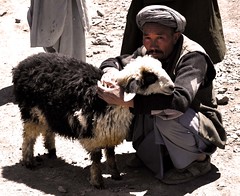
With any luck, I'll be traveling this weekend to Bamiyan province, home of Afghanistan's only female governor, two empty niches where gigantic Buddha statues stood until Taliban forces destroyed them, and a series of deep turquoise lakes called Band-e-Amir. While mine will be a short tourist's visit, however, my friend Afreen has been in Bamiyan for two weeks touring schools and development projects in villages far outside the provincial capital. Reading her account of local hospitality has made me sad that I won't be staying longer myself - I don't imagine I'll be on the receiving end of a sheep here in Kabul.

Monday, June 28, 2010

Photos for the day


Many of the trucks found hauling goods about Kabul are intricately decorated - these are just two samples of the many detailed paint jobs I've seen. I have no idea why anyone goes to this level of effort (the work appears to be hand-done), nor how it's become so widely popular.

Afghan Model

This morning, a colleague from the logistics section wandered in to my office carrying two scrapbooks. He addressed Wakeel, who then translated as he placed one of the albums in my hands: "these are photographs of his son, in traditional Afghan clothes."

The first few were postcard-like prints, each featuring several different outfits and printed with "Maseeh Ur Rahman Popalzai," the name of our young model. Later photographs show him posed in a rose garden; petting a goat; holding a shovel over his shoulder in front of a display of summer wheat; and endless close-ups of a serious face with an even more serious handlebar mustache.


He is wearing clothes from all over Afghanistan, and as I thumb through the pages, my colleague provides narration: "Herat... Kandahar... Kabul." Wakeel explains that Maseeh Rahman competed on a television show called Afghan Model - then corrects himself - he won Afghan Model. The second scrapbook, it turns out, is a collection of congratulations. I am asked to contribute, so I pen a brief note and sign my name. After prompting me to add "USA" next to my entry, the man asks me if I have a photograph of myself. Surely enough, it appears that most of these fan messages are accompanied by passport-sized images.

We made a deal - I'll bring a photo tomorrow for the fan book, and I get copies of a couple of the postcard photos in exchange. Handlebar mustaches are far from dreamy in my book, but I can't pass up this kind of brush with fame...

Saturday, June 26, 2010

A photo for the day


I think I like posting pictures individually - it's much simpler to pick one for the day than to prepare a full album (also, it means more new things for the handful of people I know are checking in regularly). Thoughts?

This one amuses me doubly - first, it was taken on a paved (!) street in a quiet neighborhood of wealthy residences and NGO offices in Karte Se - not where I usually see goatherders. Secondly, there really is a Kabul Fried Chicken, which has seen fit to appropriate the image of Colonel Sanders on its storefront (I've yet to get a photo of that; apologies). Strangely, the name isn't actually translated into Dari underneath - just transliterated. "Kabul Fraid Chikn" - Happy Saturday!

"Something that we've lost"

"I was standing on a busy interjunction in New Delhi with the traffic and the din and the scooters and the bikes and the elephants and the cows, and I remember thinking: These people have got something that we’ve lost. Our traffic rules and sanitation and systems make life easier and more convenient, ensure longer lifespans and perhaps a fairer society. But these things come at a cost, and the cost is what I felt there. There’s a velocity and density of life there that you don’t get in the West, and that I found oxygenating."
          --David Mitchell

First, I love this quote. There is a certain heightening of the senses sparked by the seemingly patternless hubbub found in poor, distant cities. Without familiar rules and structures, life flows along according to some complex, unwritten code entirely alien to foreign spectators; and so we stand mutely appreciative of the colors and the sounds and feel all the more alive for the experience. I certainly fell under that spell on my first visit to old-city Fes.

And yet, with "velocity and density..." Mitchell also turns this exotic, romanticised image into a critique of modern conveniences that are only tangential to the chaos he finds so beautiful. Traffic rules eliminate some of the din and the bustle, but they aren't the reason our roads back home don't have elephants or cows. The character of a new place comes from much deeper factors than the presence or absence of sanitation systems, after all. For all that I loved the Coca-Cola donkey, I was more than happy to return to the world of air conditioning when I got back to the States. The moments of wonder I find here are not at things lost in the course of Western progress - they are from a cultural history we simply never had.

While I'm still finding plenty to love about Kabul, I'm less charmed by its quirks than I was by Fes. Part of this is the lack of novelty (the traffic in Kabul was "predictably anarchic," according to my initial impressions), and part of it is that the unfamiliarities of life here come with a vague foreboding that you are in a place where the knowledge you haven't got, if you had it, could save you. Though after a month of watching and listening and settling in, I don't feel this threat as explicitly, it made the introduction less magical.

A friend once noted, "whether one is a returning child of the motherland or a nascent orientophile, there is little that sums up the difference in residential comforts, east by west, as the utter utterness of the power going out... in this regard, the municipal electric grid is indistinguishable from rain, or wind, or any force of nature whose fundamental uncertainty is irreconcilable except by améliean finger-crossing." Despite the beauty of traditional Persian calligraphy, despite the warm hospitality extended to me, despite the small joy of watching the schoolgirls clump around the ice-cream men each afternoon in their black uniforms and white scarves, ordinary life here requires much greater effort than at home. The power is more consistent than I'd have predicted, but taking a morning shower involves a trip out into the garden to plug in the water pump so as to build up adequate pressure, then another trip ten minutes later to unplug it before the overflow floods the roses. Laundry is a two-buckets-in-the-bathtub affair, and while by now I'm fairly adept at this, whatever I came here seeking is not going to be found in my Friday washing routine.

I believe it's possible to embrace the traffic and the din without mourning the ease and convenience of home. At least, I'm trying to strike that balance here: there is much to love about life in Afghanistan, from the dry walnut bars Wakeel just brought in to go with our morning tea to the proliferation of glittery headscarves I see on the street and the implicit hope I find in outlandish fashions here. I don't intend to celebrate the poverty or the inconveniences, however, as my wildest hopes entail retaining the unique and the beautiful of this place even as traffic rules and washing machines invade. Whatever their cost, it's certainly not too high.